THE CAR LOOKED PERFECT. THE HISTORY WASN’T.
How a Nearly New 2025 Chevrolet Blazer RS Exposed the Limits of a “Clean” Vehicle History Report
A late-model vehicle with fewer than 10,000 miles, attractive equipment, clean cosmetics, and a reassuring vehicle-history report can look like one of the safest purchases on the market.
Sometimes it is.
Sometimes it is exactly the vehicle that deserves the most scrutiny.
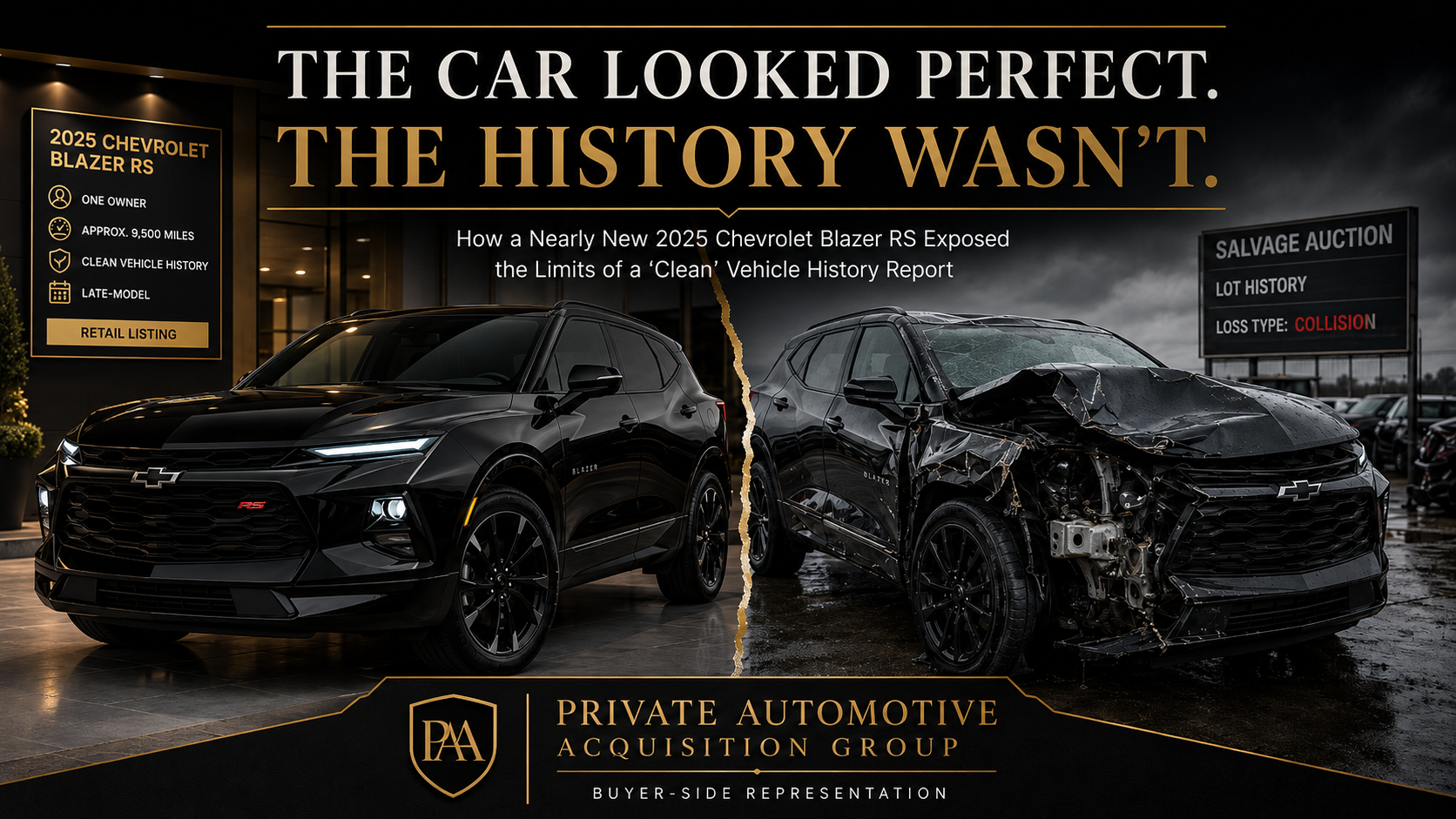
Private Automotive Acquisition recently evaluated a 2025 Chevrolet Blazer RS that, on the surface, appeared to be an exceptional opportunity. It was late-model, low-mileage, visually appealing, and advertised in Ohio as a “CARFAX One-Owner” vehicle with a “Clean Vehicle History.”
The problem was that the deeper history told a very different story.
THE VEHICLE
The Blazer had approximately 9,500 miles when it appeared for retail sale in Ohio at $31,995.
Nothing about those numbers immediately suggested a problem. In fact, the vehicle appeared to fit the profile many consumers actively seek: nearly new, relatively low mileage, desirable trim, and thousands below the cost of a comparable new vehicle.
But PAA does not evaluate a vehicle solely from the retail advertisement.
The market history, ownership pattern, auction activity, condition evidence, pricing history, and available documentation all have to tell the same story.
Here, they did not.
WHAT THE RETAIL LISTING DID NOT EXPLAIN
The investigation uncovered evidence that the Blazer had previously been used as a rental vehicle and had sustained extensive damage before ultimately entering the auction system.
On March 10, 2026, the vehicle was sold through a Houston-area salvage auction as an insurance total at approximately 9,330 miles for $23,100.
The auction photographs were materially more revealing than the later retail advertisement.
They showed severe damage affecting both the front and rear of the vehicle, including a buckled hood, substantial rear damage, a destroyed lower rear valance, damaged or hanging exhaust components, apparent displacement around a rear wheel and suspension area, and evidence that the power liftgate had become compromised.
Body-shop markings were also visible on the vehicle.
This was not the normal cosmetic wear associated with a rental return.
The condition shown in the auction evidence was consistent with a vehicle requiring substantial collision repair.
THEN THE VEHICLE REAPPEARED
After the auction transaction, the Blazer moved through the automotive ecosystem, was repaired, and eventually appeared at retail in Ohio.
By then, the odometer showed approximately 9,509 miles.
That represented only about 179 additional miles from the mileage recorded around the salvage-auction transaction.
To the next shopper, however, the vehicle could simply appear to be a remarkably low-mileage Blazer RS.
The retail presentation did not visually communicate the history visible in the earlier auction photographs.
That is precisely why professional vehicle due diligence cannot stop with the current condition of the automobile.
A properly repaired vehicle can look excellent.
Paint can shine.
Panel gaps can appear normal.
A detailed interior can look new.
The question is not merely what the vehicle looks like today.
The question is:
What happened to it before today?
“CLEAN CARFAX” DOES NOT MEAN “NOTHING HAPPENED”
This case illustrates one of the most misunderstood concepts in used-car shopping.
A vehicle-history report is a valuable tool.
It is not an omniscient record of everything that has ever happened to a vehicle.
CARFAX itself relies upon information reported through participating sources. If an accident, insurance event, repair, auction condition, or ownership circumstance is not reported into the data stream in a way that reaches the report, the consumer may not see it in the manner they expect.
In this case, CARFAX included auction-related activity, including a May 29, 2026 Auto Auction / Vehicle Sold entry and language indicating certain information was “not reported.”
But the auction evidence supplied substantially more context.
The difference between those two sources is critical.
One source presented an incomplete data trail.
The other showed the physical vehicle.
This is called “title washing.”
That is why PAA treats CARFAX and similar reports as one component of due diligence rather than the final word.
THE REAL RISK WAS NOT JUST THE DAMAGE
A heavily repaired vehicle may still function properly.
That does not automatically make it an appropriate purchase.
The buyer also has to consider:
Structural integrity.
Was the repair performed correctly and to appropriate standards?
Suspension and alignment.
Could collision forces have affected geometry or components that are not obvious during a casual inspection?
Electrical systems and sensors.
Modern vehicles incorporate cameras, radar, parking sensors, liftgate systems, lighting modules, and driver-assistance technology throughout the body structure.
Resale value.
A vehicle with significant prior damage can become much harder to sell or trade once its complete history becomes known.
Future insurability and claims.
Prior damage can complicate future loss evaluations and diminished-value considerations.
Pricing.
Most importantly, a vehicle carrying substantially greater historical risk should not be valued as though it were an ordinary clean-history example.
The issue is therefore not simply whether the vehicle was repaired.
The issue is whether the price, disclosure, risk, and buyer expectations are aligned with the actual history of the vehicle.
WHY LOW MILEAGE CAN CREATE FALSE CONFIDENCE
Consumers understandably associate low mileage with low risk.
Usually, that relationship makes sense.
A 2025 vehicle with fewer than 10,000 miles should theoretically have experienced limited mechanical wear.
But mileage measures use.
It does not measure trauma.
A vehicle can have 9,000 miles and have experienced a catastrophic collision.
A vehicle can have 60,000 miles and have lived an uneventful, meticulously maintained life.
The odometer tells you how far the vehicle traveled.
It does not tell you what happened along the way.
THIS IS WHY PAA RESEARCHES BEFORE NEGOTIATING
Had the analysis stopped at the retail advertisement, the Blazer might have looked like an attractive purchase.
The deeper investigation changed the acquisition decision entirely.
That is an important distinction in professional buyer representation.
Negotiating $1,000 or $2,000 off the wrong vehicle does not produce a good deal.
A lower price does not repair a flawed acquisition decision.
The correct sequence is:
Identify the vehicle.
Investigate the vehicle.
Establish its actual risk and market position.
Then decide whether it deserves to be negotiated at all.
Sometimes the best negotiation is the one that never takes place.
THE PAA TAKEAWAY
The modern used-car market gives consumers access to more information than ever before.
That does not mean every important fact appears neatly inside one report.
Vehicle-history reports, auction records, ownership patterns, listing history, pricing history, mileage progression, photographs, service data, condition evidence, and market comparables all contribute to the picture.
The strongest acquisition decisions occur when those sources agree.
When they do not, the discrepancy itself becomes information.
This Blazer looked like a nearly new, low-mileage vehicle with a reassuring retail presentation.
The deeper record showed why that presentation was not enough.
A vehicle can be repaired. A listing can be polished. The underlying history does not disappear.
That is why PAA investigates first and negotiates second.
Private Automotive Acquisition Group
Buyer-Side Representation
I work for you, not the dealership.