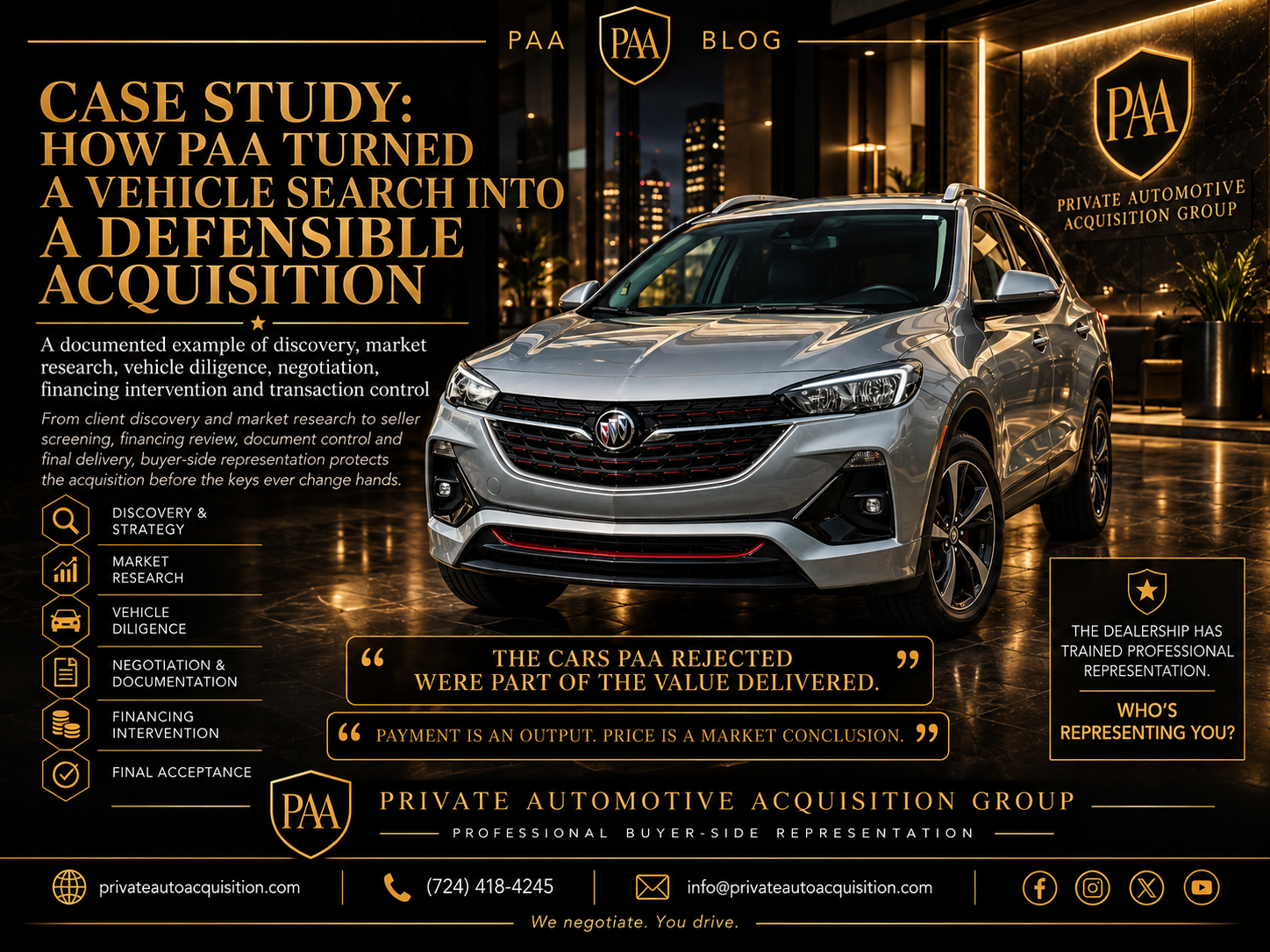
Inside a real buyer-side vehicle acquisition, from discovery and market research to VIN diligence, negotiations, financing optimization, seller underwriting and final transaction management.
By Frank J. Ranelli
Founder & CEO, Private Automotive Acquisition Group
A buyer can spend weeks scrolling listings and still know surprisingly little about the automobile he is about to purchase. That is because finding a car and underwriting an acquisition are not the same thing. The visible part of a purchase may be a test drive, a signature and a set of keys. The work that determines whether the vehicle, seller, price and transaction actually deserve the buyer’s money often happens long before delivery day.
A recent PAA engagement involving a manual-transmission American V8 performance car illustrates that difference. The client arrived with genuine enthusiasm for the category, excellent credit, defined financial boundaries and a clear intention to purchase. On the surface, the assignment sounded simple: identify the right automobile, negotiate the transaction and help the client buy it. What followed was a far more revealing example of what professional buyer-side representation actually requires.
Before a serious seller conversation began, PAA worked through client discovery, behavioral interpretation, platform comparison, market census, geographic sourcing, VIN-level research, history review, ownership chronology, modification-risk analysis, seller selection, valuation, financing posture and transaction sequencing. Multiple Mustang, Camaro and Challenger candidates were evaluated before the field narrowed toward the automobiles that actually fit the client’s long-term mission. The client did not need another website generating a list of cars. He needed someone to interpret the market, distinguish attractive listings from defensible acquisitions, explain the tradeoffs and keep successive discoveries from turning into information overload.
The cars PAA rejected were part of the value delivered, not evidence that the search was failing.
Some candidates failed quickly. Others looked promising until history, condition, ownership chronology, seller behavior or modification risk changed the analysis. One performance car presented the right engine and transmission but displayed wear and provenance concerns that weakened the risk-adjusted acquisition. Another carried serious prior-loss history. Other vehicles remained mechanically and emotionally attractive but could not justify their asking prices against the actual market. Each rejection reduced uncertainty and moved the client closer to a transaction that could survive scrutiny.
That is where professional buyer representation begins to look very different from ordinary car shopping. PAA does not assume that more horsepower automatically creates the better acquisition. It does not assume that a newer model year is automatically worth more, that a clean-history summary ends the diligence, or that the advertised price establishes value. Most importantly, PAA does not treat the seller as a neutral location where the car happens to sit. The counterparty is part of the underwriting.
A difficult seller can make a good vehicle a bad acquisition.
A strong automobile can become a poor use of the client’s time and money when the seller refuses to document the transaction, resists basic diligence, blocks an independent inspection, gives conflicting information, hides behind incomplete internet responses or cannot place a purchase-ready buyer in front of someone with actual authority. That problem appeared repeatedly during this engagement, and it exposed a structural weakness in the modern dealership internet process.
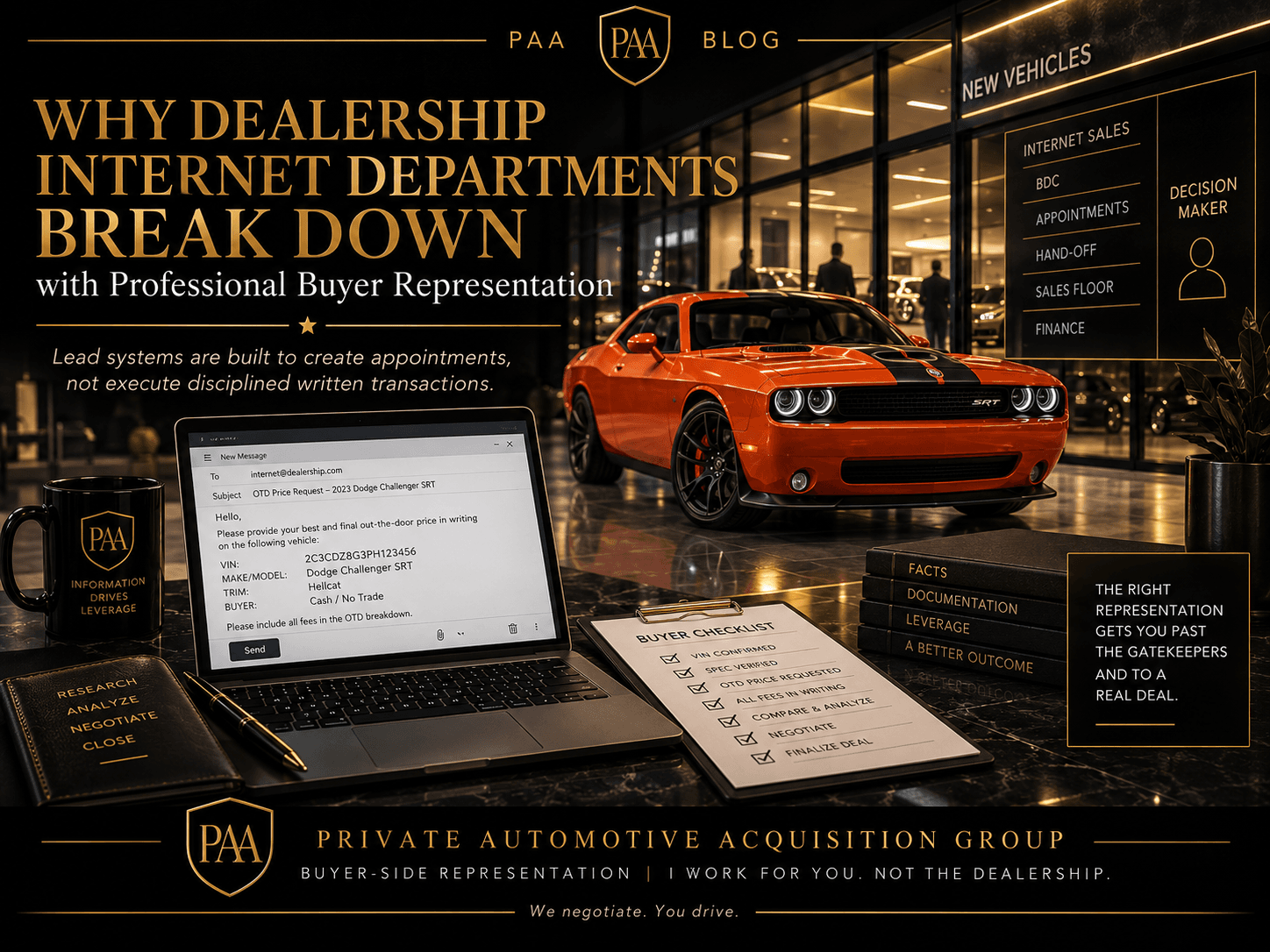
Business-development centers are generally built to convert digital leads into appointments. Their employees may be measured on response time, contact rate, phone engagement and showroom traffic. A professional buyer representative is operating on a different plane. By the time PAA contacts a seller, the client may already be qualified, the VIN already researched, the market already modeled, the financial posture already understood and the acquisition sequence already established. PAA is not asking the dealership to create interest. PAA is trying to execute a transaction.
The BDC can become an institutional gatekeeper between a purchase-ready buyer and the person actually authorized to sell the automobile.
That distinction matters. A representative may ask whether the vehicle is physically present, how many keys are included, whether it is a non-smoker, whether a current walk-around video can be provided and whether the store will provide a complete written out-the-door structure. Instead of answers, the CRM may produce an automated reply, a request for a phone number, an invitation to schedule a visit and another follow-up from someone who still cannot commit the store. The substantive questions remain unanswered because the employee handling the lead may have little authority to approve price, fees, PPI access, transaction exceptions or financing structure.
The lesson was not that written transactions do not work. PAA has completed written and remote automotive transactions before, and major automotive buying platforms operate variations of the same process at scale. The lesson was that not every rooftop is equally capable of executing one. Seller responsiveness, written OTD capability, management access, outside-PPI policy, fee transparency, financing transparency and remote-closing capability therefore become forms of acquisition intelligence, not incidental customer-service observations.
The process also reinforced why transaction sequencing matters. Vehicle economics should be established before the conversation is reduced to monthly payment. Trade value, when applicable, should be understood independently before it is blended into the deal. Financing should be benchmarked before the dealership is allowed to define affordability. Credit should be introduced when it strengthens the buyer’s position, not simply because the seller requests it early.
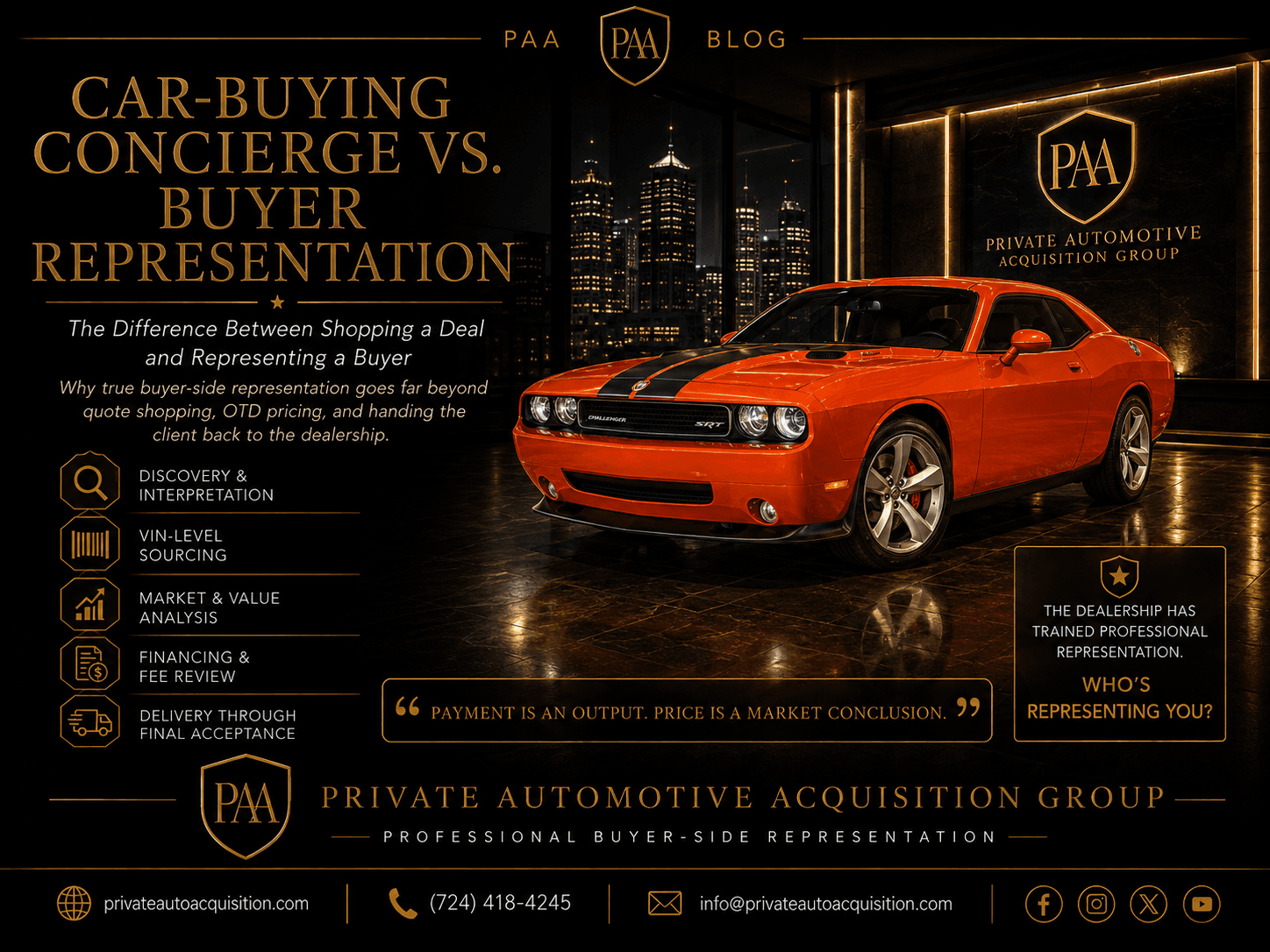
Payment is an output. Price is a market conclusion.
A payment can be moved by changing cash down, term, APR or amount financed. None of those mathematical adjustments establishes what the automobile is worth. PAA therefore works from the underlying acquisition economics outward. The same discipline applies to history and condition. Performance cars require a different kind of skepticism because a clean-looking example can have lived a hard life. Modification evidence, unusual wear, clutch and gearbox condition, tire age, service continuity, ownership turnover, auction exposure and the possibility of a vehicle being returned to stock can all matter. The right question is not merely whether the car runs. The right question is whether the total evidence supports this particular automobile, at this particular price, from this particular seller, for this particular client.
Aggressive buyer representation does not mean manufacturing a discount where the market does not support one. It means maximizing the client’s economic position across the entire transaction.
Sometimes the professional win is a large negotiated reduction. Sometimes it is not. In a thin market, the stronger decision may be recognizing that a rare, well-equipped and well-documented vehicle is already priced defensibly. At that point, forcing an arbitrary additional $1,000 or $2,000 concession can be less intelligent than securing the right automobile before another buyer does. In another situation, the correct decision may be to walk away because condition, history, seller behavior, financing or transaction structure makes the apparent bargain unattractive. Professional judgment includes knowing when to push and when further pressure would no longer improve the client’s position.
The engagement also produced an important operational lesson for PAA itself. Diligence must be rigorous, but it cannot become invisible paralysis. When a candidate dies, the client should understand why it died and what replaces it. A failed seller interaction is useful if it filters the wrong counterparty and the acquisition keeps moving. PAA therefore refined its own dealership-contact protocol: a BDC or internet representative gets one clean opportunity to respond substantively; if the response is automated, evasive, phone-dependent or clearly outside that person’s authority, the next move is escalation to the individual who actually owns the decision. The objective is not to retrain the dealership’s lead system. The objective is to reach transactional authority efficiently.
That lesson has now become institutional infrastructure. Each material dealership encounter can be converted into reusable intelligence. Which rooftops provide written OTD figures? Which permit a buyer-selected PPI? Which can complete a remote transaction? Which internet departments are primarily appointment-setting layers? Which managers actually resolve problems? Which stores disclose fees cleanly? Which sellers preserve the negotiated structure through the final buyer’s order? The next PAA client should benefit from the work performed for the previous one.
This is how buyer representation becomes more valuable over time. The consumer sees an attractive listing. PAA sees the vehicle, the history, the market, the seller, the transaction architecture, the information sequence, the financing exposure and the alternatives. The objective is not to make buying a car more complicated. It is to make the decision more defensible before tens of thousands of dollars change hands.
Buying the car is the visible part of the transaction. The research, underwriting, negotiation, financing analysis, seller evaluation and document control that determine whether it is a good acquisition usually happen before the keys ever change hands.
Considering a vehicle purchase?
Start with a free consultation. PAA will help determine whether professional buyer-side representation makes sense for your acquisition.
PRIVATE AUTOMOTIVE ACQUISITION GROUP
BUYER-SIDE REPRESENTATION
I WORK FOR YOU. NOT THE DEALERSHIP.
info@privateautoacquisition.com
(724) 418-4245
We negotiate. You drive.