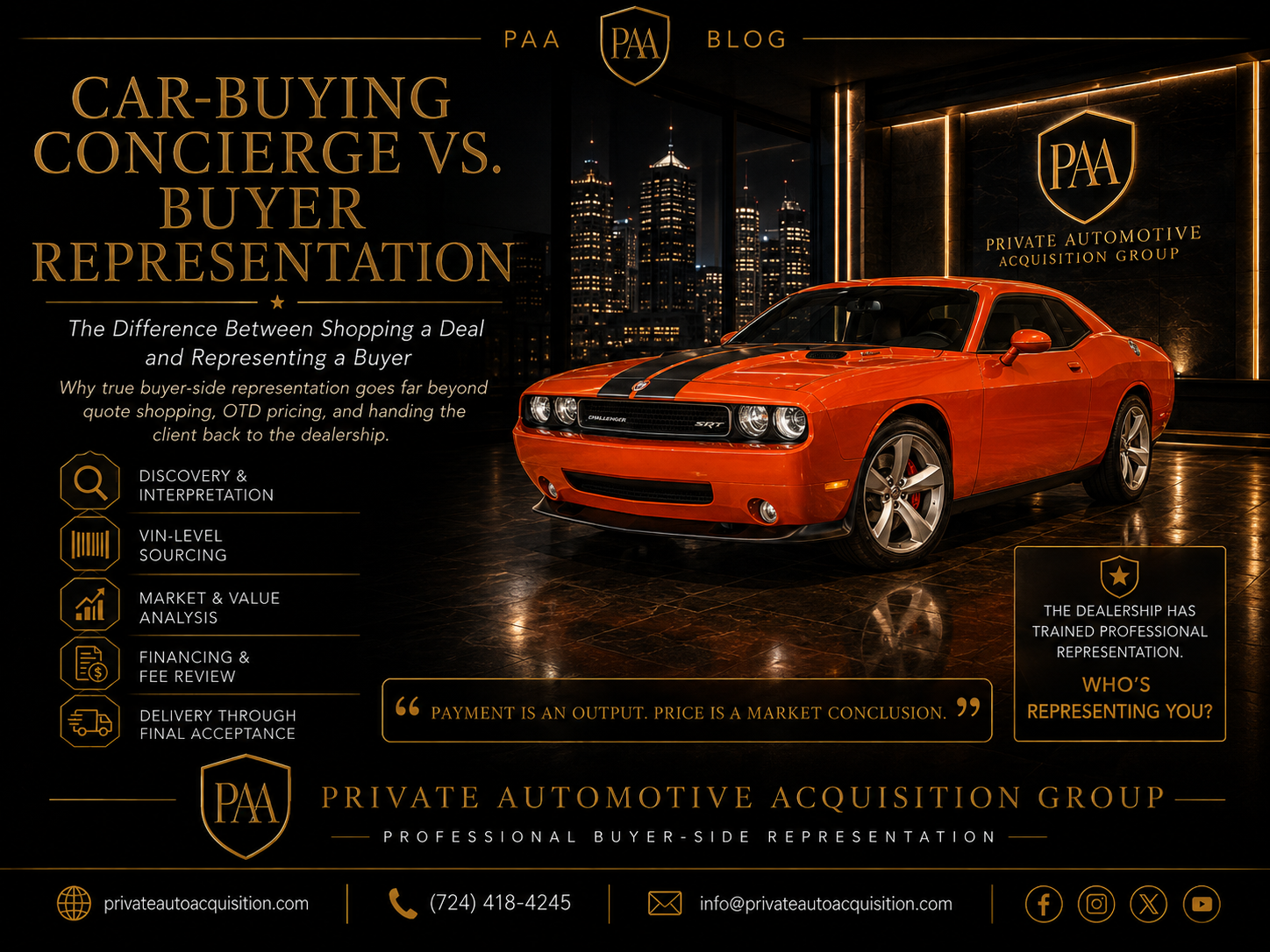
CAR-BUYING CONCIERGE VS. BUYER REPRESENTATION: They Are Not the Same Thing
By Frank J. Ranelli
Founder & CEO, Private Automotive Acquisition Group
There is a growing market for services that help consumers avoid the traditional dealership grind. Some operate as high-volume concierge businesses. Others function more like brokers. Some collect dealer quotes, negotiate remotely, or help a buyer locate inventory. These services can provide legitimate value, particularly for consumers who simply do not want to spend hours calling dealerships, sitting in showrooms, or sorting through conflicting offers.
But there is an important distinction that often gets blurred in the marketplace.
A transactional car-buying concierge service and true retained buyer-side automotive representation are not the same thing.
The distinction is not primarily about branding, pricing, or whether one service negotiates harder than another. It is about scope, responsibility, analytical depth, and where the advisor’s work begins and ends.
A concierge model may conduct discovery, identify an appropriate vehicle category, contact multiple dealerships, collect out-the-door quotes, negotiate where possible, and then hand the client back to the selling dealership to complete the transaction. That can be useful. It can save time. It can reduce friction. It can often produce a better buying experience than walking into a dealership unprepared.
Private Automotive Acquisition Group operates differently.
PAA is structured as a specialty buyer-representation firm. The objective is not simply to shop dealers against one another or produce the lowest available quote. The objective is to manage the acquisition as an integrated advisory process from discovery through final delivery, with the client’s interests represented throughout.
That difference becomes most visible in the work that occurs before a dealership is ever contacted.
THE ACQUISITION STARTS BEFORE THE SEARCH
A buyer may arrive believing he already knows what he wants. That is often useful, but it is not necessarily the same thing as knowing which automobile actually best fits the underlying mission.
That distinction matters.
Client discovery at PAA is not simply asking for a make, model, color, budget, and ZIP code. It involves understanding how the automobile will actually be used, what matters most to the client, what tradeoffs are acceptable, which characteristics are emotional preferences and which are genuine requirements, how ownership duration affects the decision, what financial boundaries exist, and where risk tolerance lies.
That discovery process is followed by behavioral interpretation.
A client may say he wants a particular vehicle because of styling, brand familiarity, horsepower, perceived reliability, or something he has already test-driven. But the deeper question is whether that vehicle actually satisfies the use case better than the alternatives.
This is where vehicle-platform comparison begins.
Instead of producing a list of loosely similar vehicles and asking the buyer which one looks best, PAA evaluates competing platforms against the client’s actual priorities. Performance, drivetrain architecture, reliability history, depreciation, service exposure, insurance considerations, equipment, ergonomics, market availability, purchase economics, modification risk, resale prospects, and other relevant variables may all affect the recommendation.
At some point, an advisor has to stop merely presenting information and start interpreting it.
That is where representation begins to separate itself from shopping assistance.
A LIST OF CARS IS NOT A PROFESSIONAL RECOMMENDATION
Information overload has become one of the defining problems in modern vehicle purchasing.
Consumers can now find thousands of listings, reviews, videos, forums, pricing tools, historical data points, and contradictory opinions within minutes. The challenge is no longer obtaining information.
The challenge is determining which information matters.
A true buyer’s representative must eventually synthesize the evidence, narrow the field, rank the alternatives, explain the tradeoffs, and make a professional recommendation.
The recent acquisition work PAA performed for a client illustrates this clearly. The client entered the process with a strong initial preference for one type of performance vehicle. Through disciplined discovery, platform comparison, successive market research, VIN-level sourcing, history screening, and financial analysis, the acquisition evolved.
That evolution was not a failure to follow the client’s instructions.
It was the advisory process working correctly.
The purpose of professional representation is not to obediently reinforce the buyer’s first assumption. It is to determine whether that assumption survives scrutiny.
Sometimes it does.
Sometimes it does not.
The value lies in finding out before the wrong automobile is purchased.
MARKET CENSUS BEFORE DEALER CONTACT
Once the target platform becomes clear, the work becomes more granular.
PAA performs a market census to understand actual supply. That means evaluating how many relevant vehicles exist, where they are located, how they are equipped, how long they have been on the market, how pricing clusters geographically, which examples are unusually strong or weak, and whether the apparent market price is supported by real inventory.
This matters because negotiation without market context is largely theater.
A buyer cannot intelligently negotiate a vehicle simply by deciding that the asking price “feels high” or that every dealership should automatically discount another $1,000.
Price must be grounded in the market.
Payment is an output. Price is a market conclusion.
That distinction is fundamental.
Monthly payment is the mathematical result of amount financed, interest rate, and term. It should not be the basis for determining whether the automobile itself is correctly priced.
Vehicle valuation requires something different: market-position analysis.
PAA examines comparable vehicles, mileage, equipment, condition, history, geographic scarcity, market age, seller position, ownership chronology, and other factors that influence value. The goal is to determine where the particular VIN sits within the actual market, not merely to obtain a generic pricing-guide number.
VIN-LEVEL SOURCING CHANGES THE ANALYSIS
Two vehicles with the same year, make, model, trim, mileage, and asking price may represent very different risks.
That is why sourcing eventually has to become VIN-specific.
PAA reviews vehicle history, title information, provenance, ownership chronology, reported incidents, registration patterns, auction exposure where visible, service history where available, and other indicators that may materially affect the acquisition.
Modification-risk analysis can also become critical, particularly in performance vehicles.
A superficially attractive example may have been tuned, raced, heavily modified, repeatedly resold, returned to stock before sale, or exposed to ownership patterns that materially change the risk profile. A lower-priced vehicle can become the more expensive acquisition if the history is wrong.
Similarly, seller selection matters.
A strong automobile sold by a weak or opaque seller may create unnecessary transaction risk. A professionally represented buyer should therefore evaluate not only the vehicle, but also the seller’s credibility, documentation quality, policies, communication behavior, pricing posture, and willingness to support a clean transaction.
Geographic sourcing strategy enters here as well. The best vehicle may not be five miles from the buyer’s house. Sometimes widening the radius materially improves condition, configuration, price, history, or seller quality. Other times, transport costs eliminate the apparent advantage.
The decision has to be modeled rather than guessed.
NEGOTIATION IS ONLY ONE PART OF THE ECONOMIC RESULT
Price negotiation matters, but it is not the entire transaction.
That point is easy to lose because car-buying marketing often reduces success to a single number:
“How much did you get off?”
That is not how PAA measures a transaction.
Aggressive buyer representation does not mean manufacturing a discount where the market does not support one. It means maximizing the client’s economic position across the entire transaction.
There are situations in which forcing another arbitrary $1,000 or $2,000 discount is neither realistic nor intelligent. If the vehicle is unusually strong, correctly priced, scarce in the desired configuration, supported by market data, and offered by a credible seller, the professional win may be recognizing that the asking price is already defensible.
The value then shifts elsewhere.
Perhaps the win is locating an exceptional vehicle the client did not know existed.
Perhaps it is establishing that the apparent bargain elsewhere carries history or modification risk.
Perhaps it is preventing a weak trade allowance from being hidden behind an attractive selling price.
Perhaps it is securing better financing.
Perhaps it is eliminating unnecessary products and fees.
Perhaps it is protecting the buyer from signing a materially different contract than the deal that was negotiated.
Perhaps it is simply knowing when the deal is already good enough to stop negotiating and buy the right automobile before someone else does.
That is professional judgment.
It is not the same thing as quote shopping.
TRANSACTION SEQUENCING IS PART OF REPRESENTATION
A vehicle purchase contains multiple economic components: vehicle price, trade value, financing, dealer fees, optional products, taxes, incentives, cash down, loan term, and final contract language.
The order in which those components are introduced matters.
PAA manages transaction sequencing and information control deliberately.
Vehicle economics should be established before the transaction becomes a monthly-payment conversation. Trade value should be independently understood before it is blended into the replacement vehicle. Financing should be benchmarked before dealership financing is accepted. Creditworthiness should be introduced when it becomes useful to the buyer, not simply because the seller asks for it early.
This is another reason representation goes beyond negotiation.
A seller can give away money in one part of a transaction and recover it somewhere else.
The buyer therefore needs someone watching the complete economic structure, not simply celebrating a discount off MSRP.
TRADE VALUE REQUIRES ITS OWN ANALYSIS
Where a trade is involved, PAA independently evaluates it.
That may include market valuation, external acquisition bids, tax-effect analysis, payoff position, equity or negative equity, condition, mileage, and comparative disposition strategies.
The purpose is to establish what the trade is actually worth before the dealership begins using the allowance as another flexible variable in the deal.
A dealer may increase the trade figure while reducing movement elsewhere. It may present statutory tax savings as though they are dealership consideration. It may blend payoff, allowance, and replacement-vehicle pricing into a payment that looks acceptable while obscuring the actual economics.
Representation means separating those components.
FINANCING DESERVES THE SAME SCRUTINY AS PRICE
Financing is not a clerical step that happens after the “real deal” is finished.
It is part of the deal.
PAA compares lender options, APR, term, amount financed, cash-down alternatives, manufacturer programs where applicable, and the overall cost of borrowing.
That includes examining the relationship between lender buy rate and consumer sell rate where the information is available or inferable from the transaction structure, as well as evaluating whether the selected term is creating an attractive payment at the expense of excessive total interest.
Educational financial tools and loan stratification help the client understand those consequences.
Again:
Payment is an output. Price is a market conclusion.
A lower payment can be produced by extending the term. That does not necessarily improve the transaction.
A professional advisor has to distinguish affordability from value.
DEALER FEES AND PRODUCTS CAN REWRITE THE ECONOMICS
A negotiated vehicle price can be undermined by everything that happens afterward.
Documentation fees, protection packages, accessories, service contracts, GAP coverage, appearance products, wheel-and-tire coverage, maintenance plans, finance reserve, and other items can materially alter the transaction.
Some products may be useful for a particular client.
Others may not be.
The role of buyer representation is not to reflexively reject everything sold in F&I. It is to determine whether the product is appropriate, correctly priced, competitively available, and consistent with the client’s risk profile and ownership plan.
The same principle applies to dealer fees.
The buyer should understand which charges are mandatory, which are discretionary, which are negotiable, and which simply represent additional dealer revenue.
THE BUYER’S ORDER IS NOT THE END OF THE PROCESS
A negotiated deal is only valuable if the final documents reflect it.
PAA reviews the buyer’s order and transaction documents for consistency with the negotiated structure. Vehicle price, trade allowance, payoff, financing terms, products, fees, taxes, cash down, and other material items should reconcile.
Where appropriate, PPI coordination may also be part of the process, particularly for used, performance, specialty, geographically distant, or higher-risk vehicles.
Delivery protection matters as well.
A vehicle should not simply be accepted because everyone is tired and the paperwork has already been signed. Condition, equipment, keys, accessories, promised repairs, documentation, and other delivery items may still require verification.
The transaction is not complete because the dealer says, “Congratulations.”
It is complete when the client receives the automobile that was represented and the transaction that was agreed upon.
THE EMOTIONAL FIREWALL MATTERS MORE THAN PEOPLE REALIZE
Vehicle purchasing is not purely analytical.
People become excited.
They become tired.
They fear losing the car.
They become attached to a color, option package, salesperson, trade value, payment, or narrative.
Dealership sales processes are built around momentum. That does not make every dealership dishonest. It simply reflects the reality that sellers are trained to move transactions toward completion.
A retained buyer’s representative provides an emotional firewall between buyer and seller.
That firewall allows someone outside the emotional center of the transaction to say:
This vehicle is wrong.
This price is unsupported.
This financing is too expensive.
This history concerns me.
This fee is unnecessary.
This is the right car.
This price is fair.
Stop negotiating.
Buy it.
The last two are just as important as the first five.
Professional representation is not valuable because the advisor always says no.
It is valuable because the advisor knows when the evidence supports yes.
WRITTEN REPRESENTATION CREATES ACCOUNTABILITY
PAA also maintains a written, auditable transaction record from discovery through delivery.
That means recommendations, market findings, seller communications, pricing, financing, transaction changes, and material decisions are documented.
This improves clarity, reduces misunderstanding, creates continuity, and allows the client to understand not merely what decision was made, but why.
It also changes the quality of dealership interaction.
Written communication reduces improvisation and makes it substantially more difficult for material terms to drift unnoticed.
In a transaction involving tens of thousands of dollars, documentation is not bureaucracy.
It is protection.
VOLUME AND DEPTH ARE DIFFERENT BUSINESS MODELS
High-volume concierge businesses can provide real value.
Consumers clearly demonstrate a willingness to pay someone to reduce dealership frustration, gather quotes, negotiate remotely, and streamline the buying process. There is nothing inherently inferior about that model.
But volume and depth create different operating architectures.
A service designed to process hundreds of transactions cannot necessarily devote the same amount of individualized analytical time to each acquisition as a specialty retained advisory firm handling a much smaller client roster.
That is not criticism.
It is economics.
PAA is deliberately built around lower volume and greater depth.
The service is high-touch, analytical, individualized, and advisory. The objective is not merely to make dealership contact disappear. It is to improve the quality of the acquisition itself.
That means researching more deeply when the transaction requires it, challenging the client’s initial assumptions when the evidence warrants it, narrowing choices, interpreting conflicting information, recommending the best alternative, managing the economic structure, reviewing the documentation, and remaining involved until delivery.
In other words, the product is not simply convenience.
It is representation.
THE DIFFERENCE IS WHOSE SIDE OF THE TRANSACTION YOU ARE ON
The dealership already has professionals representing its interests.
The salesperson represents the dealership.
The sales manager represents the dealership.
The used-car manager represents the dealership.
The F&I department represents the dealership.
Their responsibility is to protect the seller’s economics and complete the transaction on terms acceptable to the store.
There is nothing surprising about that.
The unusual part is that the buyer traditionally enters the same transaction without equivalent representation.
That is the gap PAA exists to fill.
Not as a dealer.
Not as a lead generator.
Not merely as a quote-shopping service.
As a professional buyer-side acquisition advisor whose job is to understand the client, understand the market, understand the vehicle, understand the transaction, and protect the buyer’s economic position from discovery through delivery.
Because buying a car and being professionally represented while buying one are two very different things.
PRIVATE AUTOMOTIVE ACQUISITION GROUP
PROFESSIONAL BUYER-SIDE REPRESENTATION
I WORK FOR YOU. NOT THE DEALERSHIP.
We negotiate. You drive.