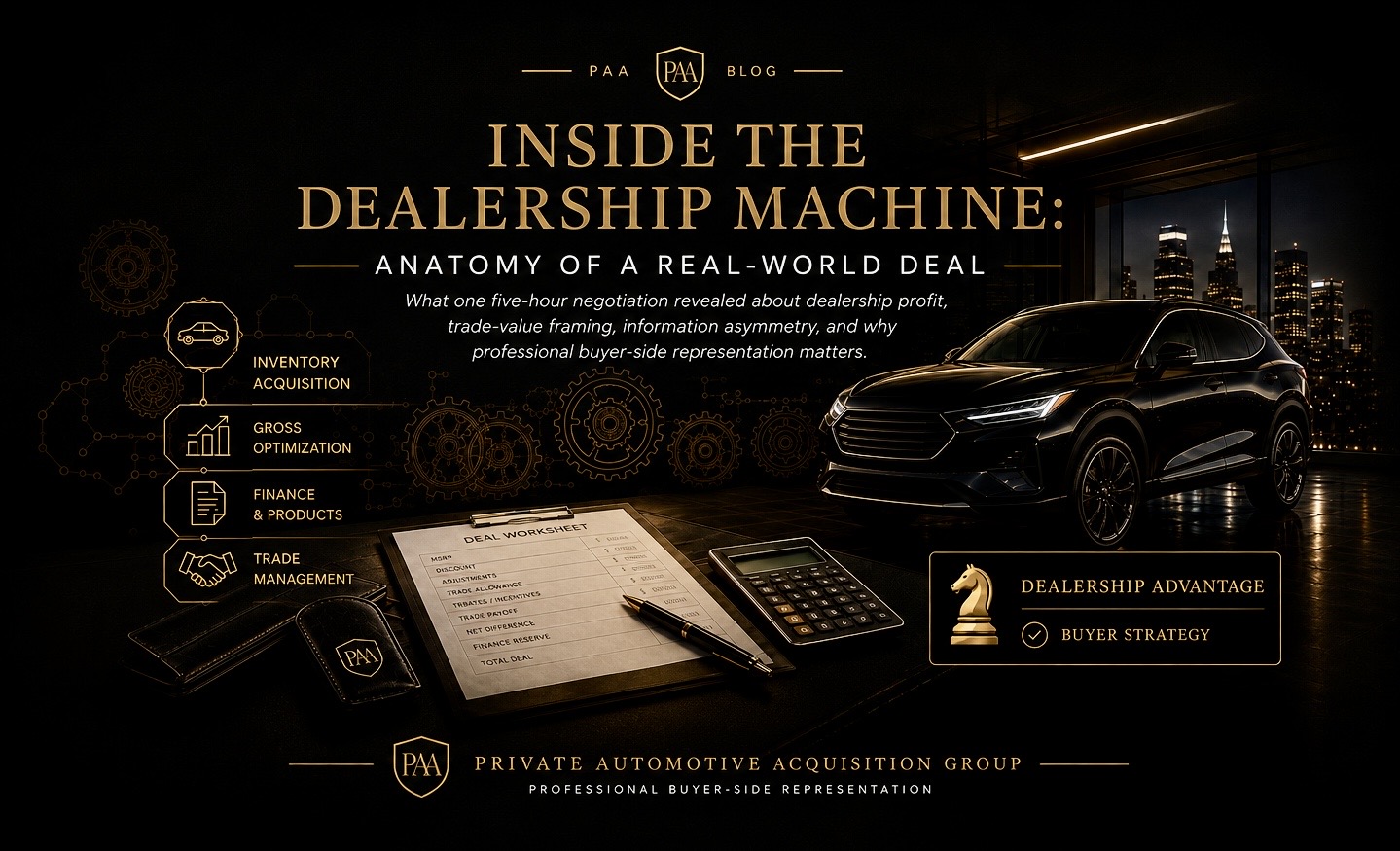
Inside the Dealership Machine: Anatomy of a Real-World Deal
What one five-hour negotiation revealed about dealership profit, trade-value framing, information asymmetry, and why professional buyer-side representation matters
I rarely conduct vehicle acquisitions by physically sitting inside a dealership.
Most PAA transactions are handled through structured written communication, market analysis, documented negotiation, and remote transaction coordination.
For this particular client, however, there were exceptional reasons to handle the final negotiation in person.
The vehicle was local.
The dealership relationship already existed.
The purchase vehicle had been thoroughly analyzed.
The trade had been independently valued through multiple acquisition channels.
Competitive dealer offers were already documented.
Financing had been benchmarked.
The payoff was known.
The tax treatment had been calculated.
The transaction structure had already been built.
In other words, almost every informational advantage normally held by the dealership had already been reduced before the negotiation began.
And despite that level of preparation, this was not a cakewalk.
It became a five-hour grind.
At one point, I was prepared to leave.
That experience illustrates something consumers need to understand about automotive retail.
A Dealership Is a Highly Coordinated Profit Engine
A dealership is not simply a salesperson and a car.
It is an institutional sales environment.
The salesperson has a role.
The sales manager has a role.
The used-car manager has a role.
The finance manager has a role.
The appraisal systems, lender relationships, inventory software, market-pricing tools, factory programs, and internal policies all have roles.
Every professional inside that environment works for the dealership.
There is nothing inherently wrong with that.
Their job is to protect the dealership’s economics.
Your job is to protect yours.
Those are not the same objective.
The dealership exists to sell vehicles and make money.
Everything else is secondary.
The consumer’s responsibility is equally straightforward:
Negotiate the best fair transaction possible and independently evaluate every component before allowing those components to be combined into the final deal.
That means separating:
vehicle selling price,
trade allowance,
tax treatment,
financing,
fees,
F&I products,
payoff,
and final amount financed.
Each component should stand on its own before the transaction is married together.
That discipline matters because dealerships are very good at moving the conversation away from individual numbers and toward the emotional effect of the entire deal.
The Trade Became the Battlefield
The trade was a 2023 Chevrolet Blazer 2LT AWD with approximately 8,300 miles.
It was an exceptionally clean vehicle with:
very low mileage,
clean history,
excellent mechanical condition,
excellent cosmetic condition,
desirable equipment,
recent service,
executive-level ceramic protection,
and virtually no anticipated reconditioning requirement.
Before entering the dealership, PAA had already completed an extensive independent valuation.
Multiple acquisition channels converged around the mid-$26,000 range.
There were also live acquisition offers above that amount.
The evidence was broad enough that the market position was difficult to dismiss.
The dealership initially offered:
$24,500
That number did not reconcile with the market.
And when the market evidence became difficult to argue against, the negotiation shifted into something consumers encounter constantly.
Manufactured theater.
The “Tax Savings” Argument Needs to Be Retired
One of the arguments used to defend the low trade allowance involved Ohio’s net-trade sales-tax treatment.
This is one of the oldest dealership framing devices in the business.
And it needs to be retired permanently.
It is a hokey, hackneyed business trick designed to confuse the buyer. They frame the state’s tax incentive as if they are doing you a financial favor, using that math to justify underpaying you by thousands for your asset.
The dealership does not determine the tax law.
The buyer does not determine the tax law.
The State of Ohio does.
If a qualifying trade reduces the taxable amount of the replacement purchase, that is a statutory tax calculation.
It is not:
additional trade allowance,
a dealership discount,
dealer participation,
dealer generosity,
or a concession.
The dealership merely applies the required tax calculation.
The market determines the trade value.
The state determines the tax.
Those are separate categories.
Always evaluate them separately.
Then Came the Emotional Theater
When the tax framing failed, the discussion moved toward the supposed risks facing the dealership.
Blazers were supposedly difficult to sell.
They sat.
They accumulated carrying costs.
They could end up at auction.
The dealership might lose money.
This is where a professional negotiation can quickly become emotional theater.
The consumer begins hearing about the dealership’s problems rather than the market value of the consumer’s asset.
That is not relevant.
The dealership’s:
payroll,
floorplan expense,
carrying costs,
inventory risk,
auction exposure,
sales quotas,
gross targets,
and internal profitability requirements
are not the buyer’s responsibility.
They are legitimate dealership concerns.
They simply do not belong on the consumer’s side of the ledger.
The same principle applies to familiar statements such as:
“This price is only good today.”
“Someone else is looking at the car.”
“We’re losing money.”
“My salesperson has to eat too.”
“We have too much invested in this vehicle.”
“These cars don’t sell.”
These statements are designed to create urgency, scarcity, guilt, fatigue, or emotional obligation.
None of them establish market value.
The buyer does not owe a multimillion-dollar automotive organization an emotional subsidy.
The buyer owes the dealership only one thing:
A fair opportunity to earn the business.
Nothing more.
The Blazer Claim Was Particularly Weak
The suggestion that Chevrolet Blazers were difficult to sell did not reconcile with the market research.
New Blazers can approach $50,000 in higher trim levels and continue to sell.
The dealership itself had previously indicated that desirable Blazers could be difficult to keep in stock.
Used Blazers, particularly clean, low-mileage examples with desirable equipment, continue to move through the market.
More importantly, the extensive research completed before the transaction showed no evidence that this particular vehicle belonged to a high-market-days-supply or chronically slow-moving category.
The data did not support the narrative.
The final negotiated trade allowance became:
$26,500
The dealership accepted it.
The transaction closed.
Then the dealership’s own post-sale behavior became the most useful evidence of all.
Twenty-One Days Later
The Blazer required almost no meaningful reconditioning.
The dealership performed routine preparation:
oil and filter service,
tire rotation,
multipoint inspection,
routine retail preparation,
and CarBravo certification.
There was no major mechanical repair.
There was no significant cosmetic reconstruction.
There was no hidden reconditioning catastrophe.
The vehicle was then advertised for:
$28,600
That was an aggressive retail price.
The dealership clearly appeared to favor inventory velocity over maximum front-end gross.
And the vehicle turned in approximately:
21 days
Three weeks.
That is not the behavior of a difficult, undesirable, slow-moving asset.
That is the behavior of a highly retail-ready vehicle priced for a fast turn.
What the 21-Day Turn Actually Demonstrated
The point is not that every Blazer will sell in 21 days.
The point is not that one transaction proves the entire national market.
The point is that this specific vehicle had been portrayed during negotiation as a potentially problematic retail asset.
The actual result was the opposite.
The dealership ultimately acquired it for:
$26,500
It required minimal preparation.
It was certified.
It was advertised for:
$28,600
And it turned in approximately:
21 days
That is a very different reality from the one presented during the negotiation.
Inventory Strategy Is Not Trade Value
A dealership may decide it prefers:
$1,400 to $1,500 of gross in 21 days
rather than:
$3,000 of gross after 60 or 75 days
That is an inventory-management decision.
It may be an excellent one.
But the buyer should not subsidize that strategy by accepting an artificially low trade value.
How the dealership intends to merchandise, price, finance, certify, or ultimately dispose of the vehicle is its business.
The market value of the trade remains a separate question.
Anatomy of a Triple-Revenue Deal
This is where the full transaction becomes especially instructive.
During the negotiation, the conversation repeatedly centered on how difficult the economics supposedly were for the dealership.
But once the entire transaction is reconstructed, the dealership had multiple independent opportunities to generate revenue.
1. The New-Car Transaction
The replacement vehicle produced approximately:
$1,200
in dealership economics through the combination of invoice spread, factory participation, holdback, and related program income.
2. The Trade-In Turn
The dealership acquired the Blazer for:
$26,500
It subsequently advertised the vehicle for:
$28,600
After approximately $700 in estimated pack, certification, and preparation expense, the transaction created roughly:
$1,400
in potential front-end gross at the advertised price.
The exact final selling price is not publicly known, so the exact realized gross cannot be stated with certainty.
What is known is that the dealership acquired the vehicle, prepared it with minimal expense, marketed it aggressively, and turned it quickly.
3. The Financing
The dealership was deliberately allowed to arrange the financing.
The lender paid the dealership an approximately:
$225 flat
for originating the loan.
That was another independent revenue stream.
And that still does not include any additional profit opportunity generated by:
GAP,
service contracts,
maintenance products,
accessories,
finance reserve where applicable,
future service,
or F&I products sold to the eventual used-vehicle purchaser.
Dealership Profit Is Not the Problem
This point matters.
There is nothing improper about the dealership making money.
It should make money.
The transaction has to work for both sides.
The problem is not dealership profit.
The problem is using theater, blended numbers, or informational asymmetry to make the consumer believe that a fair transaction is somehow unreasonable.
Those are very different things.
A dealership can say:
“We need sufficient margin to make this trade work.”
That is legitimate.
A dealership can say:
“We want to price this vehicle aggressively because we value inventory turn.”
That is legitimate.
But telling the buyer that a market-supported trade value is impossible because:
the dealership is supposedly losing money,
the vehicle supposedly will not sell,
or the buyer is already “getting” statutory tax savings
is a different proposition.
Those claims should survive contact with objective data.
In this transaction, they did not.
Why This Matters Even More Than the Numbers
The most important part of this case study is not whether the trade should have been worth $24,500, $26,500, or $27,000.
It is what happened despite extensive preparation.
The client entered the dealership with:
comprehensive vehicle research,
multiple competing written offers,
independent trade valuation,
live acquisition data,
financing benchmarks,
current payoff information,
tax analysis,
a fully structured transaction,
and the willingness to walk away.
The informational asymmetry had been reduced dramatically.
And the transaction still became a five-hour negotiation.
That should tell consumers something.
If this environment can become difficult even after that level of preparation, imagine entering it with:
no independent trade valuation,
no financing benchmark,
no competing proposal,
no knowledge of invoice,
no understanding of tax treatment,
no exit strategy,
and no professional advocate.
That is the normal retail buyer.
The Dealership Has a Team
The dealership has professionals representing its financial interests at every stage of the transaction.
The consumer usually has nobody.
That is the gap Private Automotive Acquisition Group exists to fill.
PAA is not a car-finding service.
It does not simply search listings and tell a customer where to buy a vehicle.
PAA provides professional buyer-side representation throughout the transaction.
That includes:
vehicle selection and evaluation,
market analysis,
vehicle-history analysis,
trade valuation,
dealer negotiation,
transaction structuring,
financing review,
tax and fee analysis,
contract review,
and consumer protection.
The objective is simple:
Reduce the informational asymmetry and put professional representation on the buyer’s side of the table.
Because the dealership already has a team.
Who is representing you?
The Bottom Line
A dealership is a highly coordinated automotive retail organization designed to sell vehicles and produce profit.
That is its job.
The buyer’s job is not to feel guilty about that.
The buyer’s job is to:
Separate the numbers.
Understand the market.
Ignore emotional theater.
Evaluate every component independently.
Combine the transaction only after every component makes sense.
Remain willing to walk away.
And most importantly:
Never confuse the dealership’s financial interests with your own.
Private Automotive Acquisition Group
Professional Buyer-Side Representation
The dealership already has trained professional representation. Who’s representing you?
We negotiate. You drive.