They still want to sell the car. The problem is that their lead system is designed to create appointments, not execute disciplined written transactions.
By Frank J. Ranelli
Founder & CEO, Private Automotive Acquisition Group
Modern dealerships have invested heavily in internet sales departments, business development centers, CRM systems, chat tools, automated responses, lead-routing software, appointment-setting teams and digital retail platforms. On paper, all of that should make buying a car remotely easier than ever.
In practice, a strange thing happens when a purchase-ready buyer approaches the dealership through a professional buyer-side representative.
The system often breaks down.
Not because the buyer is unqualified. Not because the automobile is unavailable. Not because the dealership does not want to sell cars.
The problem is more structural than that.
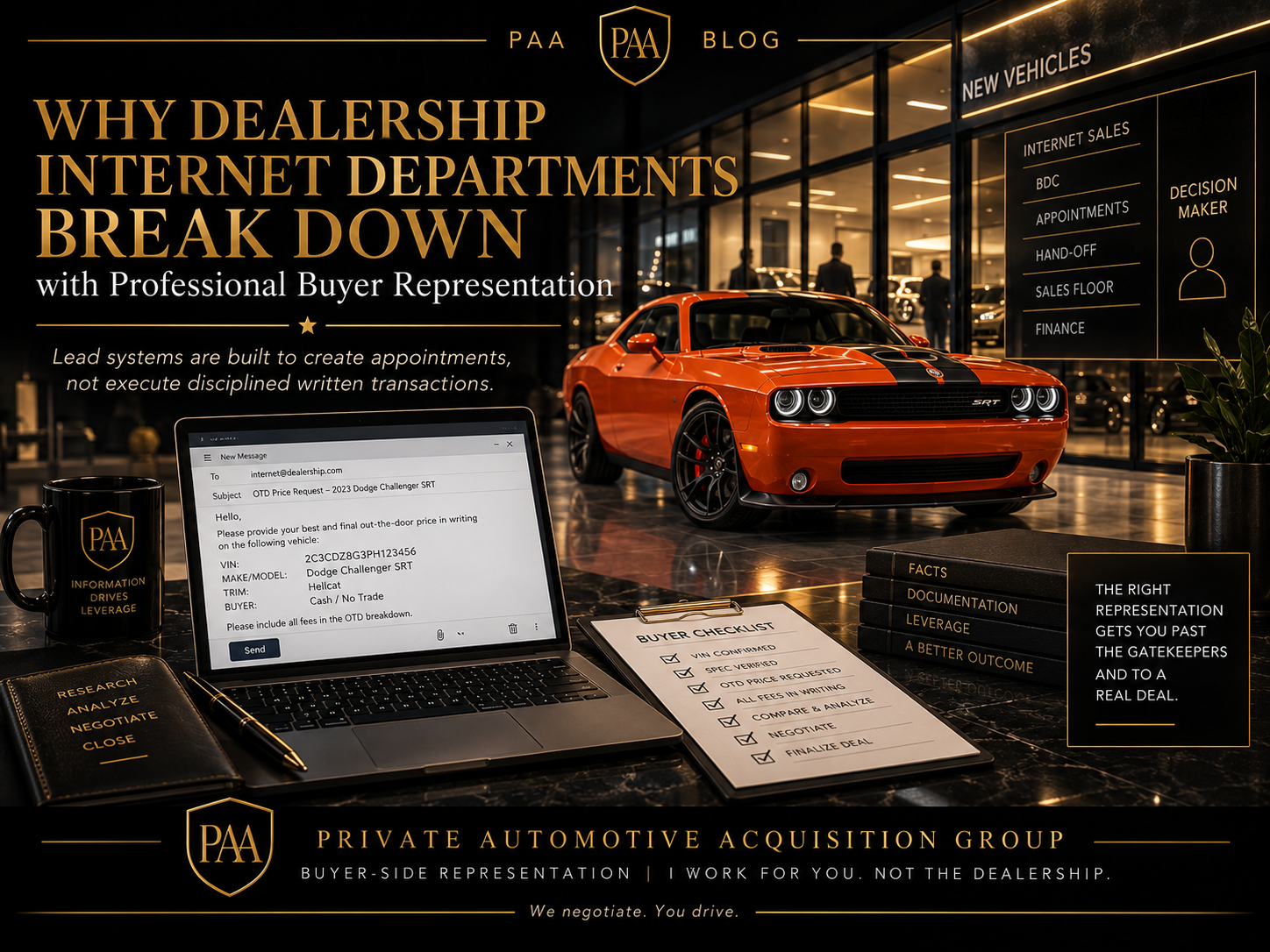
Dealership internet departments are usually optimized to convert leads into appointments. Professional buyer representation is designed to execute a controlled acquisition.
Those are not the same job.
A typical internet lead enters a dealership CRM with a very specific objective attached to it. Capture the name. Capture the phone number. Make contact. Create urgency. Move the customer into a phone conversation. Schedule an appointment. Get the person physically into the store and hand the opportunity to someone who can work the deal.
That process makes sense from the dealership’s perspective because most retail shoppers still buy that way.
Private Automotive Acquisition Group does not operate that way.
When PAA contacts a dealership on behalf of a client, the transaction has usually advanced well beyond the point of casual interest. Client discovery has already occurred. The target vehicle platform has been narrowed. Market research has been completed. Specific VINs have been screened. History, title, provenance and modification risk may already have been evaluated. Geographic sourcing has been considered. The seller has been selected for further diligence. The client’s financial posture is understood. The next step is not “Would you like to come in?”
The next step may be as simple as confirming whether the vehicle is physically present, how many factory keys are included, whether it is a non-smoker, whether a current walk-around video can be provided, and whether the dealership will ultimately provide a complete written out-the-door structure.
That is where the friction begins.
The BDC can become an institutional gatekeeper between a purchase-ready buyer and the person actually authorized to sell the automobile.
That is the part consumers rarely see.
The title “Internet Sales Manager” sounds as though the person has authority to sell the vehicle remotely. Sometimes that is true. Frequently, however, the role is closer to business development than actual transactional authority. The employee may be responsible for response time, lead engagement and appointment conversion, but may have little authority to approve a selling price, waive a fee, authorize an outside inspection, commit the dealership to an out-the-door number, alter financing structure, or resolve a transaction exception.
The employee is doing the job the dealership hired that person to do. The problem is that the job may have almost nothing to do with what a professional buyer representative needs at that moment.
This explains why a surprisingly simple written inquiry can become difficult. The representative asks a direct question. The dealership responds with a request for a phone number. The representative repeats the question. The dealership asks when the customer can come in. An automated text arrives. Another person enters the conversation. The original question remains unanswered.
The issue is not communication style.
It is workflow incompatibility.
PAA is running an acquisition protocol. The dealership’s business development center is running a lead-conversion protocol.
One system is trying to determine whether this specific automobile, at this specific seller, on these specific terms, deserves the client’s money.
The other is trying to convert a digital inquiry into showroom traffic.
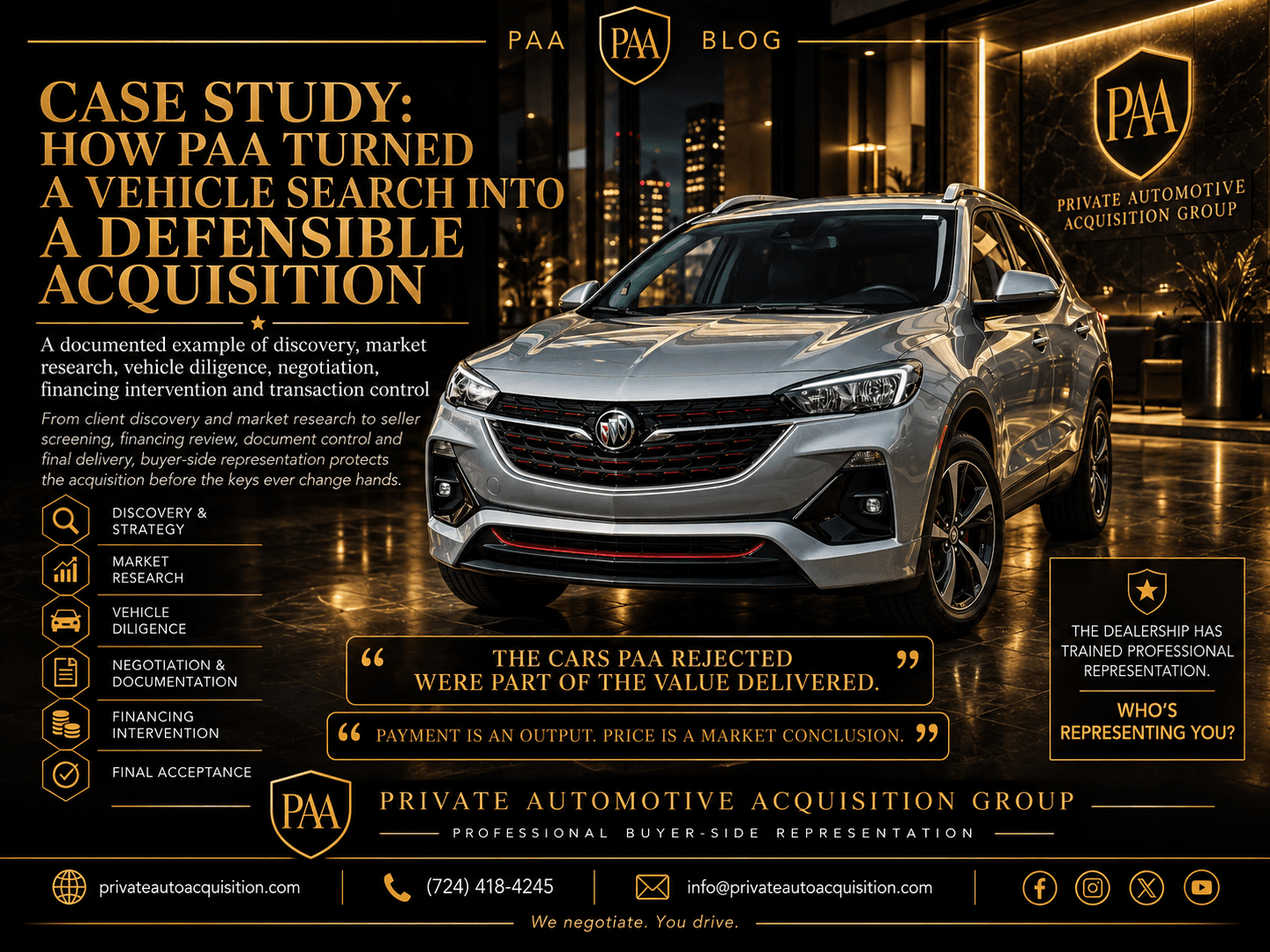
That distinction became unusually clear during a recent PAA acquisition involving a specialty used performance vehicle. The underlying client details are not important here. What matters is what the process exposed.
A highly qualified buyer was ready to purchase the correct automobile. PAA had already completed substantial market work before contacting the selling dealerships. Specific VINs had been screened. Vehicle histories had been reviewed. Alternative candidates had been compared. Condition, equipment, modification risk, seller quality and financing posture were all being considered within a disciplined acquisition sequence.
Yet repeatedly, the greatest obstacle was not the automobile.
It was getting past the front end of the dealership’s digital lead system and reaching someone who actually had the authority to transact.
That is a very different problem from “the dealership would not negotiate.”
It is possible for the dealership to want the sale while simultaneously preferring not to sell the car through a tightly controlled written process.
That distinction matters because a conventional retail transaction gives the store more flexibility. When the consumer is physically present, the conversation can move among selling price, monthly payment, trade allowance, cash down, term, lender, optional products and delivery timing. Variables can be introduced gradually. A concession in one area can potentially be recovered somewhere else.
Written buyer-side representation compresses those variables.
The vehicle is identified by VIN. Questions are documented. Out-the-door figures are requested in writing. Trade value, if applicable, is analyzed independently. Financing is introduced only when financing becomes relevant. Credit is not disclosed prematurely. Fees and optional products are separated from vehicle price. The buyer’s order can later be audited against the negotiated structure.
That process does not prevent the dealership from making money.
It simply reduces ambiguity.
And ambiguity is where a surprising amount of transaction economics can hide.
This is one reason some dealership employees appear far more comfortable moving a buyer into a telephone conversation or showroom visit than answering the same question in writing. A spoken conversation is fluid. A written answer is durable. A written answer can be compared. It can be audited. It can be forwarded. It creates accountability.
For professional buyer representation, that is precisely the point.
The buyer should not have to surrender process control simply because the dealership’s CRM was designed around appointment generation.
This is also where large, established automotive buying platforms provide an instructive comparison. Written remote negotiation clearly works at scale. Dealers respond to written out-the-door requests every day when the lead arrives through a channel they recognize, understand and value.
That tells us something important.
The methodology is not the problem.
Channel recognition is.
A large branded platform may already be known inside the dealership. The rooftop understands where the lead came from. The employee may know the expected workflow. The dealer may know that responsiveness affects a public score or a continuing stream of leads. The transaction enters the CRM as something familiar.
A boutique buyer representative can make essentially the same request and be treated very differently because the channel is unfamiliar.
The dealership may not know whether the representative is a broker, a shopper, a competitor, a vendor or simply additional work.
That is not a philosophical failure of buyer representation.
It is a routing problem.
Professional representation therefore requires something more sophisticated than simply sending better emails. It requires authority mapping.
Who inside this particular dealership actually owns the answer?
Availability may belong to the salesperson.
Current condition may require someone physically standing beside the car.
Price may belong to the desk or used-car manager.
PPI authorization may require management.
Financing structure belongs elsewhere.
A fee dispute may need a sales manager, general sales manager or F&I manager.
One of the invisible skills in a professional acquisition is knowing which person inside the dealership actually has the authority to resolve the issue in front of the buyer.
Consumers usually do not see that structure.
They see one salesperson and assume the salesperson controls the transaction.
Often, that person does not.
The same lesson applies to seller selection.
A vehicle cannot be evaluated in isolation from the counterparty offering it.
A great automobile at a difficult, opaque or unresponsive seller can become a poor acquisition once time, risk, documentation problems and transaction uncertainty are considered.
A difficult seller can make a good vehicle a bad acquisition.
That is not rhetoric. It is underwriting.
A seller that refuses to document price, avoids basic condition questions, resists an independent inspection, gives conflicting information, or forces every interaction toward a showroom appointment adds friction and risk to the acquisition.
That friction has an economic cost.
It consumes time. It can delay inspection. It can cause the buyer to miss another vehicle. It can create uncertainty around travel or shipping. It can undermine confidence in the seller’s representations. It can create unnecessary credit activity or deposits before the asset has been validated.
Professional representation has to account for those costs.
That does not mean every slow response should cause a vehicle to be abandoned.
It does mean silence and evasiveness are data.
That was another important lesson from the recent PAA acquisition process.
No response is not always an absence of information.
Sometimes it is information.
A dealership that cannot answer four straightforward written questions before asking the buyer to travel hundreds of miles is telling us something about its process quality.
A dealership that will not write an out-the-door number is telling us something.
A dealership that claims a vehicle is sold while syndicated inventory continues to display it may be telling us something else.
Professional buyer representation exists to interpret those signals before the client is financially or emotionally committed.
The key, however, is not to confuse diligence with endless pursuit.
That lesson matters just as much.
A disciplined process should filter bad counterparties quickly, not spend days trying to convert the wrong dealership employee into the right one.
PAA’s own methodology continues to evolve accordingly.
The BDC should receive one clean, concise, professional opportunity to respond substantively. If the response is automated, evasive, phone-dependent or clearly outside that person’s authority, the next step should be escalation to someone who can actually transact.
The objective is not to retrain the dealership’s business development center.
The objective is to reach transactional authority efficiently.
That distinction shortens the acquisition cycle without surrendering the written process.
And the written process matters.
A professional buyer-side acquisition should leave behind an auditable record of what was represented, what was requested, what was offered, what changed, and what was ultimately agreed upon.
That becomes especially important when inventory feeds conflict with dealership statements, when equipment descriptions differ from factory records, when pricing appears differently across channels, or when different dealership employees provide different answers.
Memory is weak evidence.
A written transaction record is not.
The recent acquisition also reinforced another principle that PAA has been developing across multiple client engagements:
The transaction should move according to the buyer’s decision sequence, not the dealership’s sales sequence.
Those sequences are fundamentally different.
The dealership may want contact, appointment, test drive, credit application, payment discussion and commitment.
The buyer may need discovery, vehicle comparison, VIN diligence, seller diligence, valuation, written price, independent inspection, financing analysis, contract review and final acceptance.
The buyer should not be forced to reorder those steps merely because the seller’s lead system was designed around showroom conversion.
That is where professional representation earns its value.
It is not simply about negotiating harder.
It is about controlling the sequence, protecting information, selecting better counterparties, separating the economics, documenting the process and knowing when to escalate, walk away or proceed.
Dealerships still want to sell cars.
But not every dealership is equally prepared to sell one through a disciplined, fully documented buyer-side process.
That is fine.
Professional buyer representation is not designed to make every dealership behave differently.
It is designed to identify the ones that will, document the ones that will not, and keep the buyer moving toward a better counterparty.
Do not confuse a bad desk with a bad practice.
The dealership already has trained professionals representing its interests.
The buyer should have someone equally disciplined representing theirs.
PRIVATE AUTOMOTIVE ACQUISITION GROUP
BUYER-SIDE REPRESENTATION
I WORK FOR YOU. NOT THE DEALERSHIP.
We negotiate. You drive.