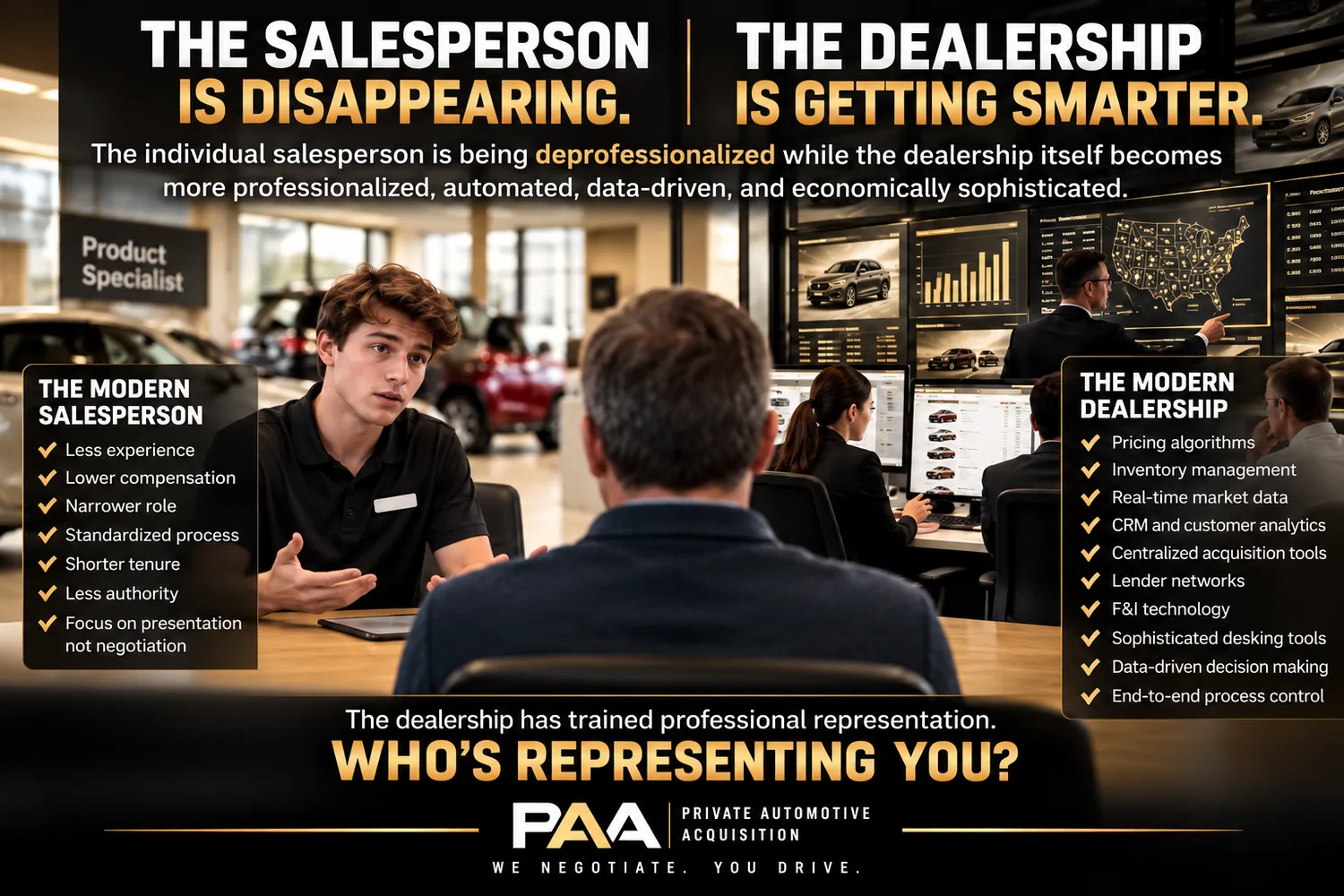
THE SALESPERSON IS DISAPPEARING. THE DEALERSHIP IS GETTING SMARTER.
The individual salesperson is being deprofessionalized while the dealership itself becomes more professionalized, automated, data-driven, and economically sophisticated.
For decades, the automobile dealership revolved around the professional salesperson. The strongest performers built careers, developed substantial product knowledge, learned how to structure transactions, cultivated repeat customers, understood trade values, worked closely with management, and often earned six-figure incomes through commissions tied to production and gross profit.
That model is changing.
Across the industry, some dealership groups are reducing traditional commission structures, separating product presentation from negotiation, introducing salaried or hourly product specialists, centralizing pricing decisions, assigning dedicated delivery specialists or vehicle ambassadors, and using technology to handle work that once depended heavily upon an experienced salesperson.
The result is a central contradiction in modern automotive retail:
The individual salesperson is being deprofessionalized at the same time the dealership institution is becoming more professionalized, automated, data-driven, and economically sophisticated.
That is not merely a change in job titles or compensation plans. It is a transfer of expertise, authority, information, and control.
Knowledge that once resided heavily with the individual salesperson is increasingly being embedded in dealership systems, management structures, pricing tools, inventory platforms, CRM technology, lender networks, acquisition systems, and centralized decision-making.
To the consumer, the dealership may appear simpler.
Behind the scenes, exactly the opposite is happening.
The individual salesperson may know less, control less, and have less experience than the career professional who occupied that role twenty years ago.
The dealership knows more.
The modern dealership does not need every person on the showroom floor to possess twenty years of experience when the organization surrounding that employee has pricing algorithms, inventory-management systems, automated lead management, real-time market data, digital-retailing tools, centralized used-vehicle acquisition systems, sophisticated desking platforms, lender networks, F&I technology, customer analytics, and management processes designed to control the transaction.
Increasingly, the salesperson is becoming the interface.
The dealership itself is becoming the professional.
And that distinction creates an even greater imbalance for the average consumer.
One example is inventory velocity.
Traditional thinking often emphasized maximizing gross profit on each individual automobile. Modern dealership groups increasingly recognize that capital tied up in aging inventory has a cost. A vehicle sold quickly at a smaller margin can sometimes produce a better annualized return than a vehicle held for weeks or months while the dealership waits for maximum gross.
That is velocity management.
The dealership may deliberately compress front-end margin, price vehicles aggressively against the market, shorten days in inventory, turn the capital faster, and repeat the cycle. That can produce very competitive advertised pricing for the consumer.
But there is another side to the equation.
When front-end vehicle margins become thinner, every other component of the transaction becomes increasingly important.
Trade acquisition becomes more important. Financing becomes more important. F&I products become more important. Parts and service become more important. Customer retention becomes more important. Used-vehicle sourcing becomes more important. Reconditioning costs become more important. Fixed operations become more important.
Profit does not disappear simply because the advertised price becomes more competitive.
It moves.
That is exactly why a low advertised price does not mean the transaction has become simple.
It means the buyer has to understand where the economics have moved.
At the same time, the traditional career salesperson is increasingly being replaced in some retail models by product specialists, delivery coordinators, customer-experience representatives, or other narrowly defined roles.
The logic is understandable.
Standardize the process. Reduce dependence on individual personalities. Separate product presentation from negotiation. Reduce payroll volatility. Create a more consistent customer experience. Make the operation easier to scale.
There can be legitimate benefits to that model.
The problem is what happens to professional judgment.
A career automobile professional may have spent years learning how lenders behave, how vehicles depreciate, how trades are appraised, how equipment affects value, how inventory age changes negotiating posture, how incentives interact, how contracts are structured, and how seemingly small changes in one part of a transaction affect another.
When that experience disappears from the customer-facing side of the dealership, it does not mean the transaction itself becomes less sophisticated.
It means the sophistication becomes concentrated elsewhere.
The salesperson is being deprofessionalized.
The dealership is not.
The desk still exists.
The used-car department still exists.
The F&I department still exists.
The lender relationships still exist.
The CRM still exists.
The inventory-management systems still exist.
The pricing tools still exist.
The dealership’s accounting, acquisition, financing, pricing, and profitability objectives still exist.
The buyer is simply interacting with a more streamlined front end connected to an increasingly sophisticated machine behind it.
And the buyer still walks in alone.
That is the part of the modern dealership transformation that deserves more attention.
Consumers are frequently told that technology has made car buying easier. In some respects, it unquestionably has.
Inventory is easier to search. Pricing is easier to compare. Vehicle histories are more accessible. Financing calculators are everywhere. Digital paperwork can reduce time inside the dealership. Online tools can make portions of the transaction more convenient.
But access to information is not the same thing as understanding the transaction.
A consumer can see thousands of listings and still buy the wrong car.
A consumer can know the advertised price and still receive a weak trade allowance.
A consumer can receive an attractive payment and still accept an unnecessarily expensive loan.
A consumer can receive a discount and lose the same money somewhere else in the deal.
A consumer can complete almost everything digitally and still sign a transaction structured primarily around the seller’s economics.
The challenge is no longer simply obtaining information.
The challenge is interpreting it.
That is why professional buyer representation becomes more relevant as dealerships become more sophisticated, not less.
Private Automotive Acquisition does not exist because dealerships are inherently adversarial (but most are) or because every automobile transaction contains something improper (but many do).
Dealerships are businesses.
They are expected to protect inventory, manage risk, produce revenue, compensate employees, generate return on capital, maintain fixed operations, and structure transactions in their own economic interest.
The dealership should represent itself professionally.
The question is why the buyer should not do the same.
PAA evaluates the vehicle independently, analyzes the market, controls transaction sequencing, evaluates the trade separately, benchmarks financing, reviews dealer fees and optional products, verifies vehicle history, audits the final numbers, and manages the transaction through delivery.
The objective is not simply to negotiate harder.
It is to understand the same transaction the dealership understands.
That distinction is becoming increasingly important because the traditional salesperson may no longer be the real center of the automobile transaction.
The dealership itself is becoming the salesperson.
Its pricing systems are selling.
Its CRM is selling.
Its inventory strategy is selling.
Its financing infrastructure is selling.
Its F&I process is selling.
Its data is selling.
Its digital-retailing platform is selling.
Its entire organization is increasingly designed to move the transaction efficiently from interest to delivery while optimizing the dealership’s economic result.
That is not necessarily bad.
It is sophisticated retailing.
But sophisticated sellers create an obvious question for buyers.
Who is providing equivalent sophistication on your side?
The dealership may be changing.
The salesperson may be changing.
The technology may be changing.
The economics may be changing.
But one fact has not changed:
The dealership has trained professional representation. Who’s representing you?
Private Automotive Acquisition exists to answer that question.
We work for you. Not the dealership.
We negotiate. You drive.